
About
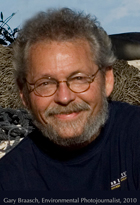
Gary Braasch is an environmental photojournalist and writer who documents nature, environment, biodiversity and global warming around the world. His images and assignment articles have been published by Time, LIFE, New York Times Magazine, Discover, Smithsonian, National Geographic, Scientific American and the United Nations among many others. Most recently, his image of the ill-fated Shell drilling rig Kulluk was the cover of NY Times Magazine (January 4, 2015). Beginning in June 2013 his images were on display for six months at the Boston Museum of Science in the one-person exhibition "Climate Change in Our World." He was the principal photographer of the June 2014 G7 meeting printed program in the sections on the theme of Climate Change. Photographs of Mt St Helens volcano and time-series images of climate change are a feature of Annenberg Foundation’s “Essential Lens” teaching unit, released February 2015.
Gary has been a nature photographer for more than 40 years. His first professional marketing and photo sales were in the spring of 1974. Commentary and prime photographs from his career will appear through 2014 on this website home page and will be archived here.
He received the Ansel Adams Award from the Sierra Club and the Outstanding Nature Photographer citation from the North American Nature Photography Association. In 2010 he was named as one of the Forty Most Influential Nature Photographers by Outdoor Photography magazine. Gary Braasch is author of Earth Under Fire: How Global Warming is Changing the World, which Al Gore calls "essential reading for every citizen." He is a founding executive committee member and Fellow of the International League of Conservation Photographers, and is a Nikon "Legend Behind the Lens."
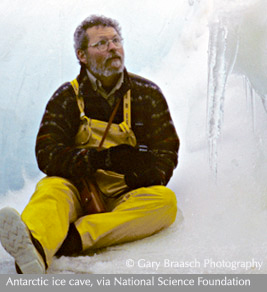
Gary Braasch's central project since 2000 has been World View of Global Warming, which is the original dedicated photo documentation of the effects of rapid climate change. Gary was the first photojournalist who journeyed extensively, including to China, Australia, Tuvalu, Antarctica, the Arctic and the great mountains of the world, documenting climate science and the effects of change. This work continues into its second decade, with new emphasis on rephotographing rapid changes and on the solutions which will reduce greenhouse gas emissions. Gary's comprehensive book Earth Under Fire: How Global Warming is Changing the World (University of California Press) was first published in 2007 and has been updated in a paperback edition and made into an e-book (2009-2010). Praise for this book has come from Al Gore, members of the Nobel Prize winning scientific community of the world, Vanity Fair, Nature, Robert F. Kennedy Jr., Bill McKibben and Paul Hawken.
 His photographs and information on climate change have been published and displayed widely. Eighteen large color prints about climate change, effects and response are on exhibition at the Boston Museum of Science beginning June 2013, along with a digital show of 100 photographs from his climate change photojournalism. In 2012, Gary collaborated with Red Hill Studios on "Painting With Time: Climate Change," an interactive app for the iPad and the iPhone. An exhibit of giant prints and educational images, "Climate Change in Our World," premiered at the American Association for the Advancement of Science, Washington DC, in November 2009, and ran for five months. Exhibitions on climate change have been shown at Chicago's Field Museum and the Science Museum of Minnesota. Images from this project are part of global warming exhibits at the California Academy of Sciences, the Koshland Museum of the National Academy of Sciences in Washington DC, and the North Carolina Museum of Natural Sciences new Nature Research Center. Gary's photographs made up the entire 2007 calendar published by the United Nations Rio Conventions (climate change, biodiversity and anti-desertification), which was presented at the UN Climate Talks in Nairobi. The United Nations used Braasch's images exclusively for a set of six stamps about climate change in 2008; more than 4 million stamps were sold. He is a member of the IUCN Commission on Education and Communications, a UN-affiliated body dedicated to preservation of wild places, cultures and creatures, and is a frequent speaker at environmental conferences and global warming seminars.
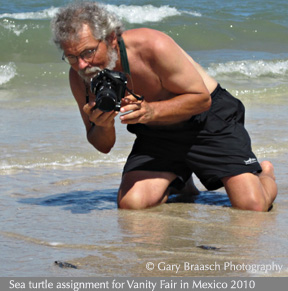 Gary Braasch is internationally known for dramatic, artistic and science-based nature photography. His work has won awards from Communication Arts and New York Art Directors Club and was the lead portfolio in a major collection of current photojournalism, What Matters (Sterling Press, 2008) along with work by Sebastiao Salgado, James Natchwey, Ed Kashi and others. His climate change work was a feature at Visa pour l'Image in Perpignan. He lectured in 2010 at the Phoenix Art Museum about time and motion in photography, in conjunction with an exhibit of Ansel Adams' works; and in 2007 at the Explorers Club Hq in New York.
Major assigned articles and portfolios of Gary's photography have appeared during recent years in NY Times Magazine, Time, LIFE, Discover, Audubon, National Wildlife, Smithsonian, Scientific American, International Wildlife, Natural History, Sierra, Animals, French Terre Sauvage, French Photo, Outdoor Photographer, Photo District News, 2wice, BBC Wildlife and the Swiss Animan magazine. In his career Gary has also illustrated major articles for National Geographic, Popular Photography, and Wildlife Conservation magazines, among several hundred publications who have published his work. His active library of detailed stock nature and travel photography serves hundreds of publishers and designers. Most of this work is on conservation or natural history subjects, the coverage of which gained Gary the Ansel Adams Award from the Sierra Club in the U.S., and the Outstanding Nature Photographer citation from the North American Nature Photography Association (NANPA). He was a founding Board Member of NANPA and a founding Fellow of the International League of Conservation Photographers.
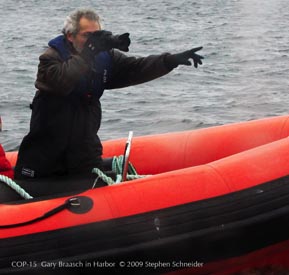 Gary Braasch's work throughout his career illustrates a global environmental reach, for example: Antarctic seabird research (International Wildlife), Great Smoky Mountains National Park biodiversity (Audubon), the threat of oil drilling in Alaska's arctic (BBC Wildlife), tropical forest studies in Peru (The Nature Conservancy), anaconda research in Venezuela (Smithsonian), honeybees and native pollinators (Natural History), endangered wood stork nesting in the Everglades (Audubon), rare plant rescue in Hawaii (Smithsonian and Discover), and climate change in Florida and Alaska (Natural Resources Defense Council).
In photographic assignments he specializes in recording the essence of whole ecosystems and threats to their biodiversity, employing techniques from aerial photography to extreme close-ups and underwater shots. Projects on ancient forests of North America, Mount St. Helens volcano, a single tropical tree, an Everglades alligator hole, and a tide pool have resulted in a book and major articles in Life magazine. Gary is known for action coverage of risk-taking field science, including volcanoes, forest canopy studies, and Antarctic geologic research.
Gary is an active contributor to environmental efforts ranging from forest preservation in his home state of Oregon to international conservation campaigns. He lives in Portland.
